FRI. 12 JUN. - 11h00
2026
Spectroscopic signatures of spin-polarons in quasi two-dimensional correlated materials
Jun 12, 2026 - 11h00 Seminar | theorie |
🧑🏫 Benjamin Lenz
🎓 IMPMC
📍 Location : Salle Roger Maynard G-421
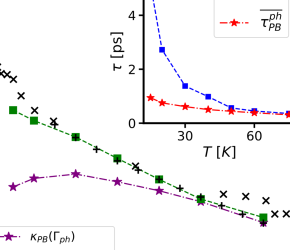
The motion of a single hole in a two-dimensional antiferromagnet can lead to the formation of a low-energy quasiparticle, a so-called spin-polaron, which amounts to a bound state of the doped hole and a spin flip. In this talk, I will first introduce the notion of spin-polarons and then discuss spectroscopic signatures of this quasiparticle at the example of two different material classes which both host quasi two-dimensional low-energy physics in their correlated electronic structure.
Illustrated by the Na-doped oxychloride Ca2CuO2Cl2, we will see how the spin-polaron gives rise to “kink” and “waterfall” features in the spectral function of hole-doped cuprates. Employing a numerical workflow comprising density functional theory and cluster dynamical mean-field theory, we will discuss these features in comparison to measurements obtained from angle-resolved photoemission spectroscopy. As a second example, we will see that spin-polaron physics is also relevant in two prototypical iridates, (Ba,Sr)2IrO4, which host an exotic spin-orbital entangled jeff=1/2 ground state. In particular, the characteristic two-peak structure of their optical absorption and optical conductivity curves will be revisited and interpreted in the light of these coherent low-energy quasiparticles.
B. Bacq-Labreuil et al., Phys. Rev. Lett. 134, 016502 (2025)
F. Cassol et al., arXiv:2509.20337; accepted in Phys. Rev. B (2026)